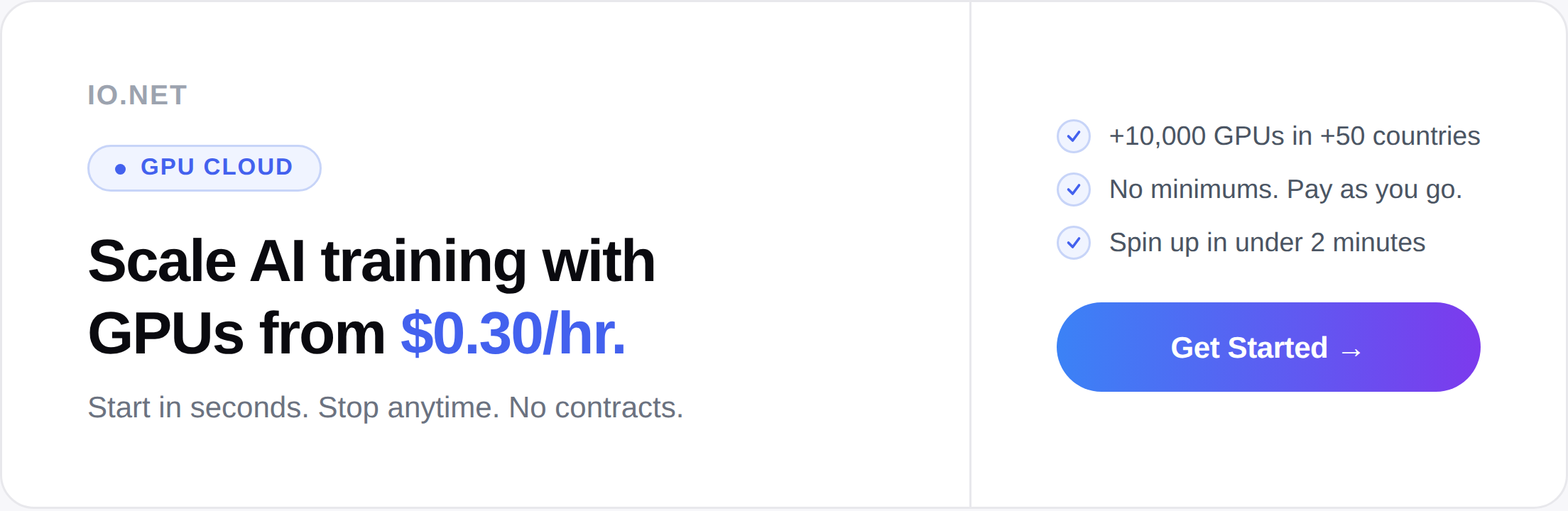
Decentralized GPU platforms like io.net deliver 50-70% cost savings, instant availability, and censorship-resistant access by aggregating underutilized GPUs globally, while centralized clouds (AWS, GCP, Azure) offer higher formal SLAs, deeper enterprise integrations, and compliance certifications. Both architectures achieve 99%+ uptime, but decentralized networks excel at scale, affordability, and eliminating GPU shortages.
Cost Comparison
Decentralized GPU (io.net):
- H100: $1.49-2.20/hr
- A100 80GB: $2.30/hr
- RTX 4090: $0.28/hr
- Savings: 50-70% below hyperscalers
Centralized Cloud (AWS):
- H100 (p5.48xlarge): $4.99-6.98/hr
- A100 80GB (p4de.24xlarge): $4.55/hr
- No RTX 4090 equivalent
- Cost: 2-3x higher for equivalent GPUs
TCO Example
10x H100 GPUs, 720 hours/month:
- AWS: $35,928-50,256/mo
- io.net: $10,728-15,840/mo
- Annual savings: $302,400-413,000
Performance & Reliability
Decentralized Networks
Uptime: 99%+ across quality providers
Provisioning: <2 minutes, no reservations
Scaling: Instant access to thousands of GPUs
Network: 10-100 Gbps, NVLink on enterprise clusters
Latency: Regional selection for <50ms inference
Centralized Clouds
Uptime: 99.9-99.99% SLA with credits
Provisioning: Minutes to hours, often waitlisted
Scaling: Limited by availability (frequent H100 shortages)
Network: 100-400 Gbps, optimized for multi-region
Latency: Global CDN, sub-10ms in premium regions
Verdict: Both hit 99%+ reliability. Decentralized wins on availability; centralized wins on formal SLA guarantees.
Features & Ecosystem
Decentralized Advantages
- No GPU shortages: Distributed supply eliminates waitlists
- Permissionless access: No KYC, no credit checks, no geographic restrictions
- Censorship resistance: No single point of failure or control
- Open pricing: Market-driven rates vs opaque enterprise pricing
- Crypto payments: Optional USDC/IO token payments
Centralized Advantages
- Managed services: SageMaker, Vertex AI, Azure ML for turnkey MLOps
- Compliance certifications: SOC 2, ISO 27001, HIPAA, FedRAMP
- Enterprise support: 24/7 phone support, dedicated account teams
- Deep integrations: Native S3/BigQuery/Cosmos DB access
- Multi-cloud: Seamless hybrid deployments
Use Case Fit
Choose Decentralized (io.net) When:
- Cost is primary constraint (50-70% savings)
- Need instant GPU access (no waitlists)
- Running open-source models (PyTorch, HuggingFace)
- Startup or research team without enterprise requirements
- Training or inference workloads on standard frameworks
Choose Centralized (AWS/GCP/Azure) When:
- Require formal SLA with financial penalties
- Need deep cloud service integrations (S3, Lambda, etc.)
- Compliance demands specific certifications (FedRAMP, HIPAA)
- Large enterprise with existing hyperscaler contracts
- Multi-cloud strategy requires consistent APIs
Security & Privacy
Decentralized: Encrypted data, private networking, Confidential Compute (TEE) for sensitive workloads. SOC 2 in progress for io.net. Best for workloads without strict compliance requirements.
Centralized: Full compliance stack (SOC 2, ISO 27001, HIPAA). Best for regulated industries (healthcare, finance, government).
The Hybrid Approach
Many teams use both:
- Development & training: Decentralized (cost-efficient, instant access)
- Production inference: Centralized (formal SLA, managed services)
Or the reverse:
- Model development: Centralized (managed Jupyter, experiment tracking)
- Large-scale training: Decentralized (50-70% savings at scale)
Future Convergence
Decentralized networks are rapidly adding enterprise features (SOC 2, HIPAA, managed services) while maintaining cost advantages. By 2027, the feature gap will narrow significantly, with decentralized platforms matching centralized capabilities at half the cost.
Start with io.net: Compare pricing or deploy your first GPU.