Why are the most successful AI teams rethinking their approach to quantum advantage? The answer lies in a convergence of new hardware capabilities, maturing software ecosystems, and shifting economics.
io.net's decentralized GPU marketplace provides the infrastructure backbone for these workloads. With H100 80GB GPUs at approximately $2.49/hr and A100 80GB at $1.89/hr, the platform delivers 40-60% savings over hyperscalers while maintaining the same hardware performance.
This guide covers quantum computing current state.
Quantum computing current state
Understanding quantum computing current state is essential for making informed infrastructure decisions. The considerations span technical requirements, cost implications, and operational complexity.
Key Metrics
| Metric | Baseline | Optimized | Improvement |
|---|---|---|---|
| Cost per inference | $0.003 | $0.001 | 67% reduction |
| Throughput (tokens/sec) | 2,000 | 6,000 | 3x |
| GPU utilization | 40% | 80% | 2x |
| Monthly cloud spend | $15,000 | $6,000 | 60% savings |
# Example deployment configuration
from ionet import Client

client = Client(api_key="your-key")
cluster = client.create_cluster(
    name="production-inference",
    gpu_type="H100_SXM",
    gpu_count=2,
    region="us-east",
)
print(f"Cluster endpoint: {cluster.endpoint}")
Hybrid quantum-classical algorithms
Understanding hybrid quantum-classical algorithms is essential for making informed infrastructure decisions. The considerations span technical requirements, cost implications, and operational complexity.
Provider Comparison
| Provider | H100 Cost/hr | Monthly (24/7) | vs. io.net |
|---|---|---|---|
| io.net | $2.49 | $1,793 | Baseline |
| AWS | $4.10 | $2,952 | +65% |
| Google Cloud | $3.90 | $2,808 | +57% |
| Azure | $4.12 | $2,966 | +65% |
| Lambda Labs | $2.99 | $2,153 | +20% |
io.net's decentralized model consistently delivers the lowest pricing for equivalent hardware.
Potential AI applications
Understanding potential ai applications is essential for making informed infrastructure decisions. The considerations span technical requirements, cost implications, and operational complexity.
The practical implementation involves several key steps that teams should follow systematically. Starting with small-scale validation before scaling to production is critical for avoiding costly mistakes.
# Example deployment configuration
from ionet import Client

client = Client(api_key="your-key")
cluster = client.create_cluster(
    name="production-inference",
    gpu_type="H100_SXM",
    gpu_count=2,
    region="us-east",
)
print(f"Cluster endpoint: {cluster.endpoint}")
Current limitations
Understanding current limitations is essential for making informed infrastructure decisions. The considerations span technical requirements, cost implications, and operational complexity.
The practical implementation involves several key steps that teams should follow systematically. Starting with small-scale validation before scaling to production is critical for avoiding costly mistakes.
Integration with GPU infrastructure
Understanding integration with gpu infrastructure is essential for making informed infrastructure decisions. The considerations span technical requirements, cost implications, and operational complexity.
The practical implementation involves several key steps that teams should follow systematically. Starting with small-scale validation before scaling to production is critical for avoiding costly mistakes.
# Example deployment configuration
from ionet import Client

client = Client(api_key="your-key")
cluster = client.create_cluster(
    name="production-inference",
    gpu_type="H100_SXM",
    gpu_count=2,
    region="us-east",
)
print(f"Cluster endpoint: {cluster.endpoint}")
Timeline for practical quantum advantage.
Understanding timeline for practical quantum advantage. is essential for making informed infrastructure decisions. The considerations span technical requirements, cost implications, and operational complexity.
The practical implementation involves several key steps that teams should follow systematically. Starting with small-scale validation before scaling to production is critical for avoiding costly mistakes.
Deploy on io.net
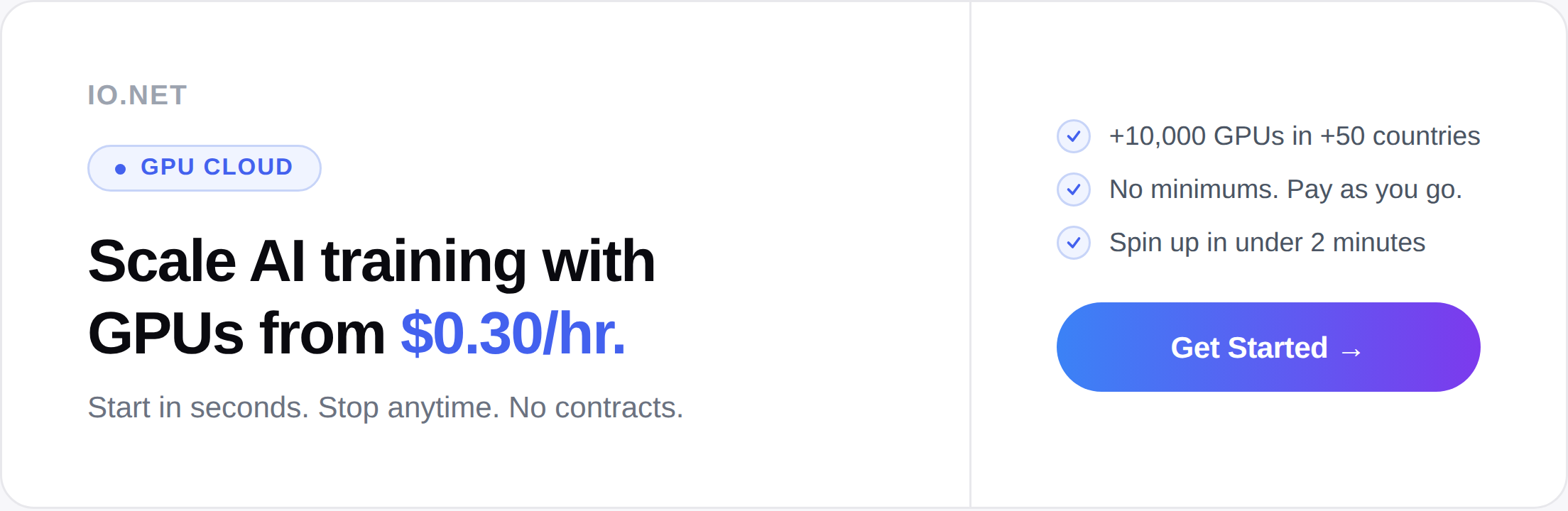
H100 GPUs at $2.49/hr. A100s at $1.89/hr. No commitments. Scale instantly.
Frequently Asked Questions
What GPU should I use for this workload?
For most production workloads, H100 80GB SXM on io.net ($2.49/hr) provides the best price-performance. For budget-conscious deployments or smaller models, A100 80GB ($1.89/hr) is an excellent alternative.
How does io.net compare to hyperscalers?
Same hardware (NVIDIA H100, A100), 40-60% lower pricing, no long-term commitments. io.net's decentralized model aggregates capacity from multiple data centers to offer competitive rates.
Can I scale up and down dynamically?
Yes. io.net's pay-by-the-hour model with no minimums allows you to scale GPU capacity based on actual demand. Add GPUs for training runs, remove them when done.
What about data security?
io.net supports encrypted data transfer, private networking between nodes, and GPU memory isolation. For regulated workloads, enterprise-tier configurations provide additional security controls.
How do I get started?
Create an io.net account, select your GPU type and quantity, and deploy your workload. Most users have their first inference endpoint running within 15 minutes.
Conclusion
Timeline for practical quantum advantage. represents a significant opportunity for AI teams in 2026. By combining the right technical approach with cost-effective infrastructure, organizations can achieve measurably better results at lower cost.
io.net's decentralized GPU marketplace provides the foundation: H100 GPUs at $2.49/hr, A100s at $1.89/hr, flexible scaling, and multi-region availability. Whether you are deploying a new model, optimizing an existing pipeline, or exploring emerging techniques, io.net gives you the compute you need at a price that makes sense.
Get started on io.net today. Create your account and deploy your first GPU cluster in minutes.