Explore our Blog for
Latest News & Insights
Stay updated with the latest updates and new products. Discover what's happening around the io.net.


io.net blog
Latest
See All
How io.net cut LLM streaming bandwidth by 98%: batching tokens in vLLM and gzipping the SSE stream took 364 bytes per token down to 7.5.
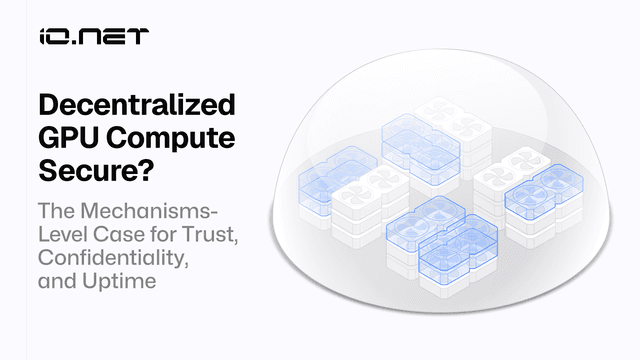
Evaluating decentralized GPU compute for production AI? Here’s what to check on confidentiality and reliability, and how io.net approaches each.
GPU availability is now its own procurement problem. Learn how to evaluate AI inference vendors on allocation, waitlists, and multi-vendor risk.
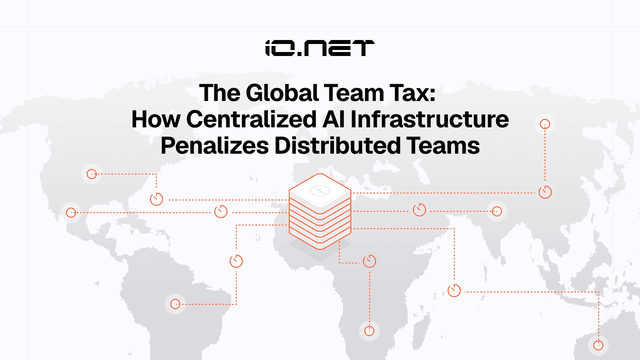
Distributed AI teams often pay a hidden “global team tax” in latency, data residency, and compliance. Here’s how regional placement can fix it.
Open-weight models now handle 71.5% of production AI tokens. See what the Western model wave means for infrastructure and GPU costs.
How a Singapore robotics startup proved their navigation AI dataset was 25x larger than competitors—and cut compute costs by 92.8% with io.cloud
The AI budget conversation is the hot topic this year. So, it’s safe to say that If you've probably heard some version of this line: token costs are falling fast and AI is about to get a lot cheaper. It's a reasonable proposition. You want to believe it. But according to Gartner's own research, it’s a notion that is mostly wrong for the people actually paying the bills. Gartner's forecast, published this spring, makes some other striking proclamations. By 2030, they believe that running infer
Let’s imagine that you’ve budgeted $10,000 for an AI/LLM training run. You hop on AWS and the app says, “no H100s available for 72 hours”. Apart from some stress and frustration, what does that delay actually cost your team? In answering that question, perhaps like Thanos, when asked by Dr. Strange how much it cost to collect the infinity rings, he replied: “Everything”. All joking aside, most finance models would record “zero”. There’s no invoice because you’ve consumed no GPU-hours. Your $10
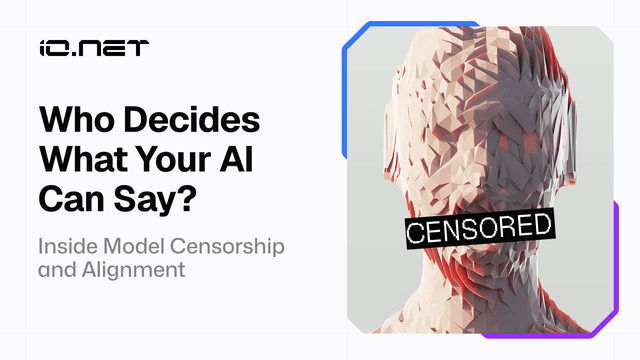
When you ask an AI to help with something and it refuses, that refusal didn't happen by accident. Someone, or more precisely, a team of researchers, lawyers, and ethicists at a major AI lab, made a deliberate choice to build that boundary into the model. Today, major model providers (e.g. OpenAI, Anthropic, Google, Meta, Mistral, and Cohere) each maintain their own alignment teams, each with distinct values, risk tolerances, and commercial pressures shaping what their models will and won't do. T
Let’s imagine that you’ve budgeted $10,000 for an AI/LLM training run. You hop on AWS and the app says, “no H100s available for 72 hours”. Apart from some stress and frustration, what does that delay actually cost your team? In answering that question, perhaps like Thanos, when asked by Dr. Strange how much it cost to collect the infinity rings, he replied: “Everything”. All joking aside, most finance models would record “zero”. There’s no invoice because you’ve consumed no GPU-hours. Your $10
io.net is utilizing the Solana blockchain for instant GPU payments, smart contract automation, and secure, decentralized cloud computing transactions.
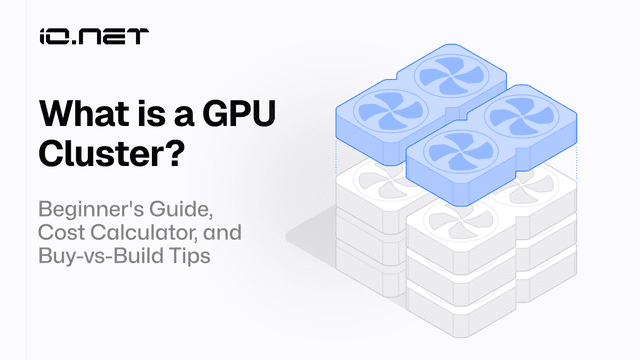
Learn what a GPU cluster is, how it differs from multi-GPU servers, and use our cost calculator to decide if you should build or rent one.
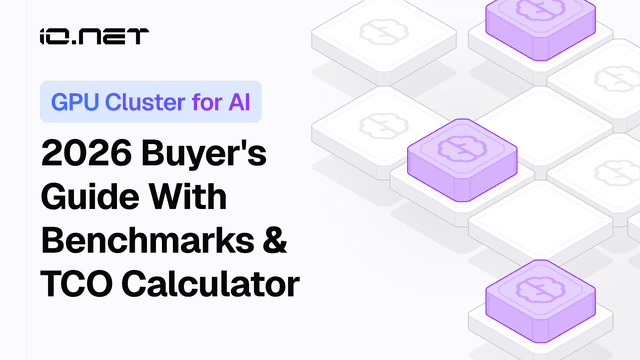
Your 2026 guide to building a purpose-built GPU cluster for AI. Includes TCO, vendor-agnostic benchmarks, hardware selection (H100/MI300X), and rollout plan.
Complete technical guide to decentralized compute: benchmarks, cost calculator, compliance checklist, and step-by-step migration from AWS/GCP.
Discover io.net's Incentive Dynamic Engine (IDE): an adaptive tokenomics model bringing sustainable economics and predictable stability to decentralized GPU compute.
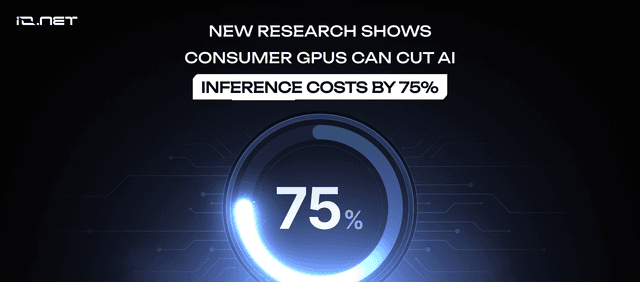
New io.net study shows consumer GPUs (RTX 4090) can cut AI inference costs by up to 75% for LLMs, enabling a sustainable, heterogeneous compute infrastructure.

Blockchain promised to solve centralization, but focused on wrong problems. DePIN networks like io.net finally deliver real value through affordable GPU access.
Latest By Topic (147)
See All
io.Intelligence delivers real-time monitoring for AI workloads, helping optimize performance, cut costs, and ensure reliable system stability.

"IO.net offers a decentralized GPU cloud, enabling scalable, cost-effective AI training, rendering, and simulations with global resources."
Master effective AI communication prompt frameworks including R-T-F, T-A-G, B-A-B, C-A-R-E, and R-I-S-E to unlock better AI results and consistent outputs.