Explore our Blog for
Latest News & Insights
Stay updated with the latest updates and new products. Discover what's happening around the io.net.

io.net blog
On June 11, 2023, io.net launched with a straightforward idea. AI workloads need more compute than centralized hyperscalers can ever deliver, and the solution would be a decentralized network of GPUs, not another mega data center, that turns underutilized capacity into on-demand infrastructure. Three years later, we’ve fundamentally changed the AI compute market. io.net is now the largest decentralized GPU network in the world. Thousands of GPUs distributed globally, with $8 million in enterpri
Three years ago, we started io.net with a simple, powerful belief that the infrastructure behind AI shouldn't be in the hands of a few giant corporations. Today, we're taking a huge step toward making that vision a reality. As we celebrate our third anniversary, we're excited to announce the official launch of the Incentive Dynamic Engine (IDE). It's a new way of thinking about our tokenomics that ties the supply of $IO directly to how much people are actually using the network. We'll be perman
Latest
See All
One of the great ironies of AI infrastructure is that AI agent workloads are structurally incompatible with how hyperscalers sell compute. The reserved-instance model designed for sustained, predictable throughput collapses under the weight of agentic pipelines that spin up 40 workers in 90 seconds, run them for 7 minutes, then need zero capacity until the next trigger fires. That’s some extremely annoying architectural friction that anyone building an AI model or incorporating it into their exi
Cloud procurement used to be a straightforward infrastructure decision. With GPU cluster growth across various clouds, from hyperscalers to neoclouds and DePIN solutions, that’s just no longer the case. Enterprise buyers now commit six- and seven-figure compute budgets to providers whose compliance posture, contractual protections, and operational reality vary enormously. This often happens in ways that aren't so obvious from a pricing page or a sales deck. This blog is your checklist coveri
The current AI infrastructure conversation has settled on one big number: 38 gigawatts. That's Morgan Stanley's estimated US data-center power shortfall through 2028. What’s creating this shortfall? The GPU compute needed for inference workloads, and what the existing grid can actually deliver to new AI data facilities on any realistic timeline. Here are some quick numbers. Grid interconnection queues are presently running 5+ years out in most major markets. Add another 2–3 years for transform
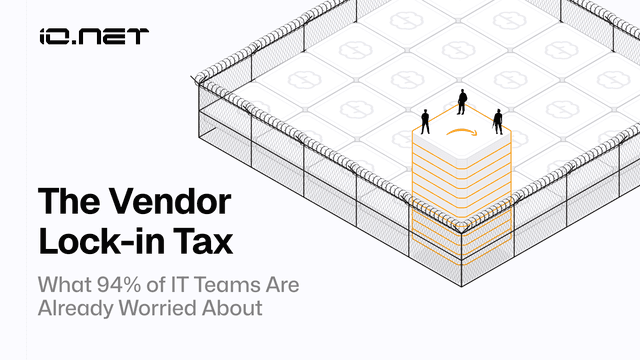
Vendor lock-in used to be the province of IT departments. Now it’s a real budget risk. According to widely-cited survey data, 94% of IT professionals report concern about vendor lock-in. For anyone dealing with AI infrastructure, that worry is about to get more expensive. On August 26, 2026, AWS announced an expanded multi-billion-dollar commitment to Nvidia GPU capacity that cemented the hyperscaler-as-gatekeeper model. It did so at precisely the moment AI workloads are scaling the fastest. W
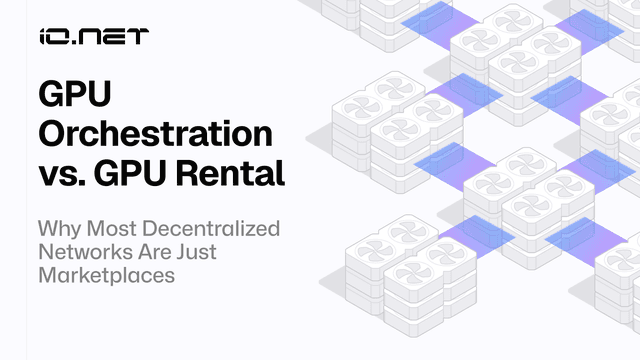
You don't need one GPU. You need 32 GPUs that talk to each other like they're in the same rack. Every DePIN network’s GPU marketing leads with price per GPU-hour. They publish comparison tables showing their H100 rates against AWS, their A100 spot costs against GCP, or their RTX 4090 per-second billing against Azure. Read between the lines and that marketing suggests that cheaper access to hardware is equivalent to actually usable infrastructure. Well, it isn't that simple. At least not for th
The AI budget conversation is the hot topic this year. So, it’s safe to say that If you've probably heard some version of this line: token costs are falling fast and AI is about to get a lot cheaper. It's a reasonable proposition. You want to believe it. But according to Gartner's own research, it’s a notion that is mostly wrong for the people actually paying the bills. Gartner's forecast, published this spring, makes some other striking proclamations. By 2030, they believe that running infer
The AI budget conversation is the hot topic this year. So, it’s safe to say that If you've probably heard some version of this line: token costs are falling fast and AI is about to get a lot cheaper. It's a reasonable proposition. You want to believe it. But according to Gartner's own research, it’s a notion that is mostly wrong for the people actually paying the bills. Gartner's forecast, published this spring, makes some other striking proclamations. By 2030, they believe that running infer
Let’s imagine that you’ve budgeted $10,000 for an AI/LLM training run. You hop on AWS and the app says, “no H100s available for 72 hours”. Apart from some stress and frustration, what does that delay actually cost your team? In answering that question, perhaps like Thanos, when asked by Dr. Strange how much it cost to collect the infinity rings, he replied: “Everything”. All joking aside, most finance models would record “zero”. There’s no invoice because you’ve consumed no GPU-hours. Your $10
When you ask an AI to help with something and it refuses, that refusal didn't happen by accident. Someone, or more precisely, a team of researchers, lawyers, and ethicists at a major AI lab, made a deliberate choice to build that boundary into the model. Today, major model providers (e.g. OpenAI, Anthropic, Google, Meta, Mistral, and Cohere) each maintain their own alignment teams, each with distinct values, risk tolerances, and commercial pressures shaping what their models will and won't do. T
Let’s imagine that you’ve budgeted $10,000 for an AI/LLM training run. You hop on AWS and the app says, “no H100s available for 72 hours”. Apart from some stress and frustration, what does that delay actually cost your team? In answering that question, perhaps like Thanos, when asked by Dr. Strange how much it cost to collect the infinity rings, he replied: “Everything”. All joking aside, most finance models would record “zero”. There’s no invoice because you’ve consumed no GPU-hours. Your $10
io.net is utilizing the Solana blockchain for instant GPU payments, smart contract automation, and secure, decentralized cloud computing transactions.
Learn what a GPU cluster is, how it differs from multi-GPU servers, and use our cost calculator to decide if you should build or rent one.
Your 2026 guide to building a purpose-built GPU cluster for AI. Includes TCO, vendor-agnostic benchmarks, hardware selection (H100/MI300X), and rollout plan.
Complete technical guide to decentralized compute: benchmarks, cost calculator, compliance checklist, and step-by-step migration from AWS/GCP.
Discover io.net's Incentive Dynamic Engine (IDE): an adaptive tokenomics model bringing sustainable economics and predictable stability to decentralized GPU compute.
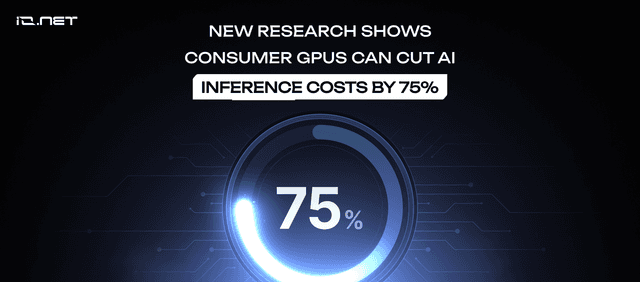
New io.net study shows consumer GPUs (RTX 4090) can cut AI inference costs by up to 75% for LLMs, enabling a sustainable, heterogeneous compute infrastructure.

Blockchain promised to solve centralization, but focused on wrong problems. DePIN networks like io.net finally deliver real value through affordable GPU access.
Latest By Topic (130)
See All
Allora Network partners with io.net to scale DeAI platform using decentralized GPUs, enhancing ML training and predictive modeling capabilities.
Filecoin partners with io.net to expand beyond storage, letting providers monetize unused GPUs for compute while strengthening both networks.
Mira partners with io.net to scale AI verification infrastructure, using decentralized compute to maintain 97-98% accuracy for 400k+ users daily.
New Retrieval Engine from io.net transforms enterprise knowledge management with citation-backed AI responses from trusted document sources.
Learn how IO Worker lets users monetize idle GPUs/CPUs by renting computing power for AI training, earning cryptocurrency rewards based on hardware quality.
Real-world case studies show how AI startups, researchers, and businesses leverage io.net's decentralized GPU network for faster, cost-effective computing.
io.net is leveraging smart contracts on the Solana blockchain to automate GPU rentals, payments, and resource allocation for transparent decentralized computing.
io.net is utilizing the Solana blockchain for instant GPU payments, smart contract automation, and secure, decentralized cloud computing transactions.
Nexus partners with io.net to expand computational power for its zkVM, enhancing zero-knowledge proof generation with decentralized GPU resources.
CreatorBid partners with io.net to scale AI agent creation and tokenization, enabling autonomous content generation with decentralized GPU compute.
Phala Network partners with io.net to expand its TEE-based coprocessor protocol, accessing 300k+ decentralized GPUs for affordable AI computing.

KREA scales AI media generation for clients like Nike and Apple using io.net's 300k+ decentralized GPUs at 60% lower costs than traditional cloud.